Guide
Under the sink: pipes, damp, and what should not live down there
The cupboard under the sink is the only storage in a house designed by a plumber. Everything about organising it follows from that one fact.
It is a deep box with a pipe through the middle, a floor that has been wet at least once, and a door that hides all of it. Things go in at the front, get pushed to the back, and are rediscovered years later when something leaks.
This guide is about making that cupboard usable: how to read the shape, what to put in it, what should never be in it, and how to catch a leak before it reaches the chipboard. The measurements come from our own catalogue, and the safety guidance is quoted from sources we read and dated rather than paraphrased from memory.
Read the plumbing before you buy anything
Open the door and look at three things. Where the trap sits, how far it hangs down, and which side the shut-off valves are on. Those three decide the shape of everything that can go in.
The trap is the U-bend below the plughole, and it is usually the lowest obstruction. Measure from the cabinet floor to the underside of it. That number, minus an inch for lifting, is the tallest rack that will slide in and out without catching.
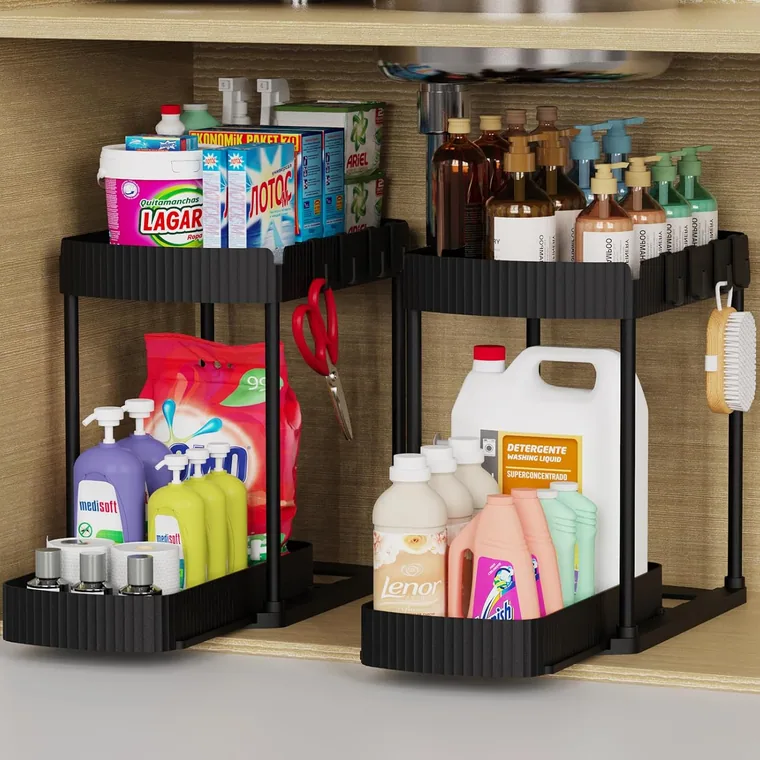
Then measure the clear floor either side of the waste pipe. In most kitchens you get two usable columns rather than one wide space. That is the reason our racks are sold in pairs at 15 by 8 inches each.
| Clear height under the trap | Rack that fits | What sits on the lower tray |
|---|---|---|
| Under 14 in | Neither, use mats and a shallow bin | Cloths, sponges, small bottles |
| 14 to 16 in | 12.8 in rack | Spray bottles, dishwasher tablets |
| 16 in and over | 14.8 in rack | Tall detergent bottles standing upright |


Two shallow racks beat one deep shelf
The failure of the standard sink cupboard is not capacity, it is access. A single deep shelf holds plenty and shows you only the front row. Everything behind the front row becomes invisible, and invisible cleaning products get bought twice.
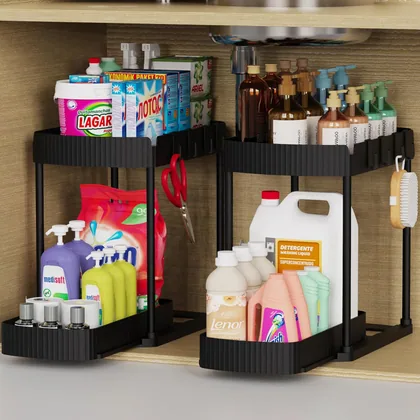
A two-tier rack with a sliding bottom tray fixes the depth problem in the only way that matters: it brings the back to the front. Two of them, one either side of the pipe, turn one cave into four reachable shelves.
One honest limitation, and it is the reason for a three-star review we publish on this site: the bottom tray slides and the top shelf does not. If you need both levels to come out, this is not the rack for you, and you should know that before ordering.
★★★☆☆
The quality is good for the price. It's much more stable than I would have thought. I wish I had paid more attention to how it functions. The bottom shelf slides out smoothly. But the top shelf is stationery. So if you want to access what's on the top shelf, you will have to feel around or pull out the whole unit. I placed it in the bathroom cabinet to hold combs, pins, clips, etc. I think I'll place it under the kitchen sink instead where I can place folded cleaning cloths and sponges on the top shelf, and buy something more in keeping with my needs for the bathroom.
That is a fair complaint fairly stated. The top shelf is fixed because it carries the frame, and a design where both levels slide is a different and more expensive product than the one we make.
The floor is the part that fails
Cabinet floors under sinks are usually chipboard with a thin laminate. Water gets under the laminate at a cut edge, the board swells, and the swelling does not go back down. By the time a floor is soft, the leak has been running for a while.
This is why a mat with a raised lip is worth more here than anywhere else in a kitchen. It is not about tidiness. It is about the leak being visible in a tray of water rather than invisible in a board.
The Environmental Protection Agency puts the timescale in one sentence, and it is the sentence that decides whether a leak is an annoyance or a repair:
If wet or damp materials or areas are dried 24-48 hours after a leak or spill happens, in most cases mold will not grow.
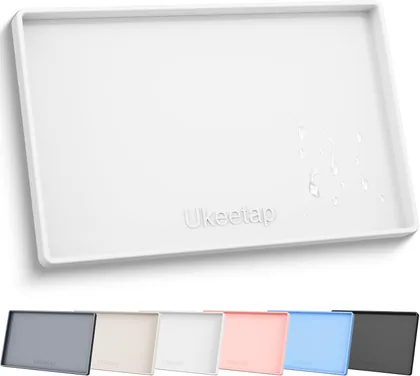
Sizing is the same discipline as everywhere else in the house: measure the cabinet floor, take an inch off each side, then choose. A mat pressed tight against the walls curls at the edge, and a curled lip pours water onto the floor it was bought to protect.
What should not be stored under a sink
This is where organising stops being about convenience. The cupboard under the sink is where most households keep bleach, drain cleaner, dishwasher tablets and spray bottles, and it is also the cupboard at the height of a toddler's shoulder.
The National Capital Poison Center is direct about the first rule, and it is the one broken most often, usually with good intentions and a spray bottle that was easier to refill than to replace:
Keep cleaning products in original containers - always!
The second rule from the same source is about neighbours on a shelf rather than about the products themselves:
Store household cleaning products away from foods and medications.
Read together, those two sentences rule out the two habits that make a sink cupboard dangerous: decanting cleaners into unlabelled bottles, and keeping the dishwasher tablets next to the spare pasta because both are kitchen things.
- Keep every cleaner in the bottle it came in, with the label on it.
- Keep cleaners on a different level from anything edible, and ideally in a different cupboard.
- If there are young children in the house, treat the under-sink cupboard as a place that needs a latch rather than a place that needs tidying.
- Sponges and cloths dry badly in a closed cupboard. They belong somewhere with air.
A rack does not make any of that safer by itself. What it does is stop the tall bottle of drain cleaner from living at the back where it is reached for blindly, which is the moment most spills happen.
Loading a rack so it stays loaded
A rack that gets unloaded and reloaded badly ends up worse than the shelf it replaced. Three details decide whether it survives the first month.
Weight goes low. The sliding tray is the one that takes the force of being pulled, so the heavy bottles belong there rather than on the fixed shelf above. A top shelf loaded with detergent makes the whole rack top-heavy the moment the bottom tray comes out.
Labels face out. This sounds fussy until you are reaching under a sink with one hand while something boils over. Bottles turned label-out are read at a glance, and bottles turned the other way get picked up and rotated, which is how they get knocked.
Leave one slot empty. Every cupboard acquires a new bottle eventually, and a rack packed to capacity forces the newcomer onto the cabinet floor, which is exactly the place this whole guide is trying to keep clear.
Damp, smell and the cupboard that never dries
A closed cupboard with a cold pipe in it is a small humidity trap. In summer the pipe sweats, the air does not move, and anything absorbent in there stays slightly damp for months.
That is where the smell comes from in an old sink cupboard. It is rarely the cleaning products, and almost always a cloth, a sponge or a cardboard box that has never fully dried out. The same EPA guidance that covers spills covers the background condition:
Keep indoor humidity low. If possible, keep indoor humidity below 60 percent (ideally between 30 and 50 percent) relative humidity.
Two practical answers follow. Keep cloths and sponges somewhere with air rather than behind a door, and take cardboard out of the cupboard entirely. A box of dishwasher tablets is fine because it gets used up. A cardboard box that lives there permanently is a wick.
The bathroom version of the same cupboard
Bathroom vanities have the same pipe and a shorter cupboard. The 12.8 inch rack is usually the one that fits, and the load is different: bottles that get used daily rather than weekly, and a lot of small items that fall over.
Two habits help more than any product. Group by routine rather than by type, so the morning things share a tray. And put the tallest bottles at the back of the sliding tray rather than the front, because a tray pulled out with tall bottles at the front tips forward.
★★★★☆
I bought the Ukeetap 2 Pack Multi-Purpose Pull-Out Storage Organizers mainly to organize the mess under my bathroom sink, and overall I’m really happy with them. The pink color is actually cute in person and adds a nicer look compared to the usual plain black organizers.The best feature is definitely the pull-out drawer. It makes it much easier to grab cleaning supplies, hair products, or extra toiletries without digging around in the back of the cabinet. Assembly was super easy too — no tools needed, and both organizers were set up in just a few minutes. The size worked well in my kitchen cabinet, but one barely fit in my smaller bathroom vanity, so measuring first is important.They feel sturdy enough for everyday items like sprays, soap refills, and paper products. I wouldn’t overload them with very heavy bottles, but for normal storage they hold up well. Some reviewers also mentioned they were larger than expected, which I agree with.For the price, getting two organizers is a good value. They instantly made my cabinets look cleaner and more organized, and I like that everything is easier to reach now. If you need affordable under-sink storage that looks nice and works well, these are worth trying.
A cupboard that stays organised
Storage that has to be maintained does not last. Three rules keep this particular cupboard in order without any maintenance at all.
- One category per tray. Cleaning on one, dishwashing on another, spare sponges and cloths on a third. Mixed trays go back to being a jumble within a fortnight.
- Nothing on the cabinet floor except the mat. The floor is for catching leaks, not for storing the big bottle that does not fit anywhere else.
- A quarterly look under the trap with a torch. It takes a minute and it is the only inspection this cupboard ever gets.
The last one matters most. Everything else in this guide is about making the cupboard usable. The torch is about finding out that the trap has been weeping for a fortnight while there is still a laminate floor to save.
What we would put in a first-time cupboard
If somebody moved into a house tomorrow and asked what to do with the sink cupboard before filling it, the order would be this, and it takes an afternoon.
- Empty it and clean the floor. Dry it properly, then look at the trap with a torch while everything is out.
- Put a mat down first, sized an inch smaller than the floor on each side.
- Fit two racks, one either side of the waste pipe, at whichever height cleared your measurement.
- Load by routine: dishwashing on one tray, surface cleaning on another, laundry things on a third if they live here.
- Leave the floor empty from then on. It is a leak detector, not a shelf.
Everything after that is maintenance you do not have to think about, which is the whole ambition. A cupboard that works is one you stop noticing.
What this cupboard cannot do
It cannot be a pantry. Food stored next to cleaners is a rule broken by geography rather than intention, and the guidance above is unambiguous about it.
It cannot be dry storage for anything that matters. The pipes sweat in summer, the trap drips eventually, and paper or fabric kept down there will smell of the cupboard within a season.
And it cannot hold more than it holds. Racks make the space usable, not larger. If the cupboard is full with two racks in it, the answer is fewer bottles, which is free.
Read next
If the measuring part is where this went wrong before, the guide to measuring covers drawers, cupboards and cabinet floors in order. If the kitchen bottleneck is dinner rather than storage, the prep night guide takes the chopper and the shredder apart.
Sources
- U.S. Environmental Protection Agency, A Brief Guide to Mold, Moisture and Your Home, read 31 August 2026
- National Capital Poison Center, Why container transfers are dangerous, read 31 August 2026
This guide is general information about storage and kitchen equipment. For questions about the safety of a specific product in your home, read the labelling that came with it.