Guide
Measure first: fitting an organiser to the drawer you actually have
Almost every organiser that gets returned was the wrong size, not the wrong product. Ten minutes with a tape measure is the difference, and most of that time is spent finding the tape.
Kitchen drawers are not standard. A run of cabinets fitted in 2015 gives you interior widths around 21 inches. A kitchen from the seventies is often 12 or 13. Older houses that were fitted twice have both in the same room. Nothing on a product page can rescue you from that, so this guide starts with a tape measure rather than a catalogue.
What follows is the measuring order we use ourselves, the four numbers that decide everything, and the honest limits of what an expandable tray can do. The figures for our own products come from the catalogue on this site, and the food safety and moisture advice is quoted from sources we read and dated.
The four numbers that decide it
Take them in this order, write them on your phone, and take the phone shopping.
- Interior width, measured at the narrowest point. Runners and drawer sides eat an inch or more, and the narrow point is usually at the back.
- Interior depth, front to back, measured inside the drawer box rather than across the front panel.
- Clear height, from the drawer floor to whatever passes over it when the drawer closes. In a cabinet this is the underside of the worktop or the rail.
- The longest thing you plan to put in. A whisk, a slotted spoon, a pair of tongs. This is the number people forget, and it is the one that decides whether the tray is any use.
Three of those four are about the space. The fourth is about you, and it is the one that changes which compartment count you need.
Why expandable exists
A fixed tray solves one width. If your drawer is not that width you get dead space, and dead space in a cutlery drawer fills with teaspoons and small lids within a month. An expandable tray solves a range instead of a point.
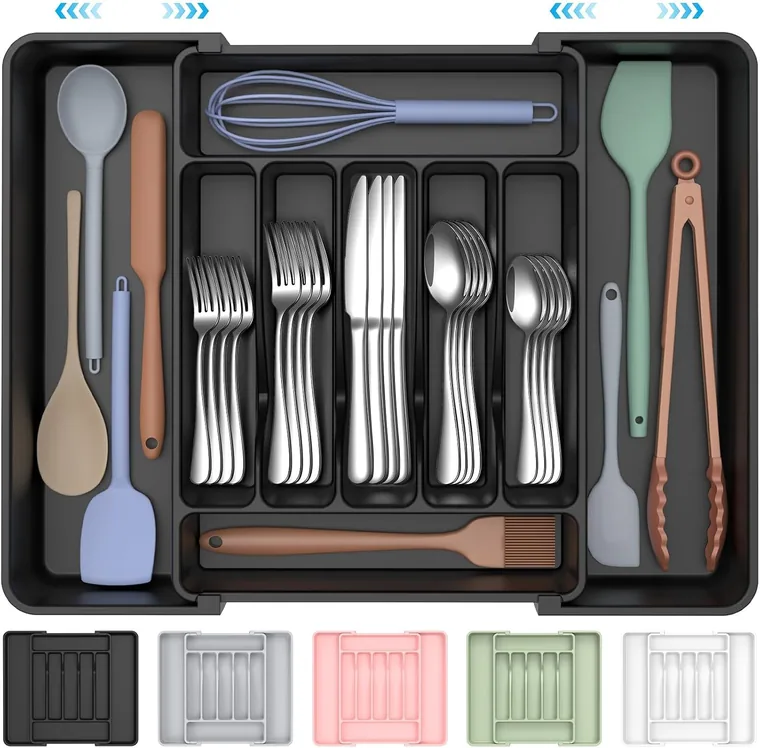
The trays in the Ukeetap range run from 12.4 inches closed to 21 inches at full stretch. Two side panels slide out on a buckle, and the compartment count goes from seven to nine as they open. That range covers the two common cabinet generations mentioned above with one product.
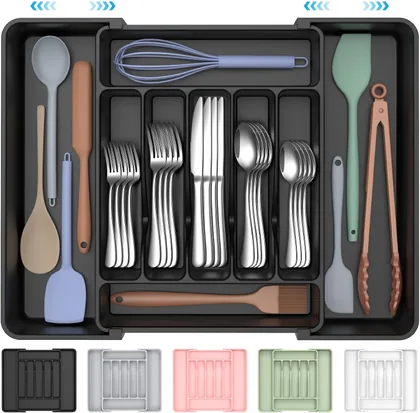


There is a limit, and it is worth saying out loud. At full width the tray braces against the drawer sides and stays put. Set to a middle width in a much wider drawer, it can travel when the drawer is pulled hard. A strip of shelf liner underneath settles it, and that is a two-dollar fix rather than a design flaw.
★★★★★
We have a wide silverware drawer and I've struggled for years finding the right organizer. When I discovered this one, I think my search is over!Pros: This one is expandable, which met my top need. I was able to make it wide enough to take up the width of the drawer.With the 5 main slots, I have places for my different sized spoons and forks, as well as knives. The long slots on the sides are great for bigger knives and can openers. There are also slots at the top and bottom. It's sturdier than I expected, another plus. It will also be easy to clean.Con: while it is wide and spacious, I wish it were a little longer so it would take up my whole drawer, but that's not a deal breaker by any means! It may be too big for a standard drawer, so pay attention to measurements.Versatility: I may order more to organize my desk at school and my bathroom drawer.Overall, this was a great value for the price and I'm thrilled with this product.
Depth is the number people skip
Width gets all the attention because it is the number on the box. Depth decides whether the tray sits flat or rides up on the back rail, and a tray that rides up is a tray that rattles.
Our trays are 16.5 inches front to back. In a 21-inch-deep drawer that leaves a strip behind the tray, which is a reasonable home for a rolling pin or a bag of skewers. In a 15-inch drawer the tray will not sit down at all, and no amount of pressing will change that.
| Product | Footprint | Height | Fits when |
|---|---|---|---|
| Silverware tray | 12.4 to 21 in wide, 16.5 in deep | 1.77 in | Interior depth is 17 in or more |
| Under-sink rack, low | 15 x 8 in | 12.8 in | Clear height under the trap is 14 in or more |
| Under-sink rack, tall | 15 x 8 in | 14.8 in | Clear height under the trap is 16 in or more |
| Silicone mat, small | 19 x 12 in | 0.6 in | Cabinet floor is 20 in wide or more |
| Silicone mat, full width | 34 x 22 in | 0.6 in | Cabinet floor is 35 in wide or more |
The right-hand column is the one to read twice. Every figure in it is the product dimension plus an inch, because an organiser that exactly matches its space fights the walls and stops sitting flat.
The cupboard under the sink is a different problem
Drawers are rectangles. The cupboard under a sink is a rectangle with a drain pipe through the middle of it, a shut-off valve somewhere awkward, and a floor that has probably been wet at least once.
Measure the clear height under the trap rather than the height of the cupboard opening, because the trap is what a rack has to pass beneath. Then measure the free width either side of the pipe. Two narrow racks usually beat one wide one, and our racks come two to a box for that reason.
The full version of that argument, including what should and should not live in that cupboard, is in our guide to the sink cabinet.
★★★☆☆
The quality is good for the price. It's much more stable than I would have thought. I wish I had paid more attention to how it functions. The bottom shelf slides out smoothly. But the top shelf is stationery. So if you want to access what's on the top shelf, you will have to feel around or pull out the whole unit. I placed it in the bathroom cabinet to hold combs, pins, clips, etc. I think I'll place it under the kitchen sink instead where I can place folded cleaning cloths and sponges on the top shelf, and buy something more in keeping with my needs for the bathroom.
That review is three stars and it stays on this site because it is fair. The bottom tray of our racks pulls out and the top shelf does not, and somebody measuring for a cupboard they cannot easily kneel in front of deserves to know that before ordering rather than after.
Cabinet floors, mats and the inch you leave
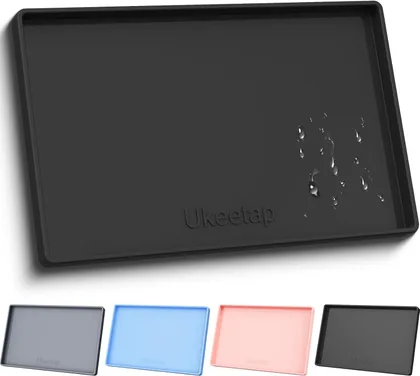
A mat is measured the same way as a tray, with one extra rule: leave an inch on each side. A silicone mat cut tight to the cabinet walls curls at the edge, and a curled lip pours a spill instead of holding it.
Our mats run from 19 by 12 inches up to 40 by 22, in eight sizes, because cabinet floors under sinks are as varied as drawer widths. The lip is what makes the mat worth buying: it holds a slow leak in view until somebody notices it.
Why bother catching a small leak at all? Because a damp cabinet floor is the beginning of a longer story. The Environmental Protection Agency puts the timing plainly:
If wet or damp materials or areas are dried 24-48 hours after a leak or spill happens, in most cases mold will not grow.
Twenty-four to forty-eight hours is not much of a window if the leak is behind a row of bottles you cannot see past. A mat with a lip buys you the chance to see it.
Storage bags and the space above the wardrobe
The same discipline applies to soft storage, with the difference that the constraint is usually the shelf rather than the bag. Measure the shelf depth first, because a 27-inch bag on a 24-inch shelf hangs over the edge and slides off the first time somebody bumps it.
Our storage bags are 27 by 15 by 13.5 inches and hold 24 gallons, which is roughly a duvet and two pillows or four winter coats. They fold flat between seasons, which is the reason to choose fabric over rigid boxes for a job that happens twice a year.
One rule about what goes in them matters more than any measurement: put things away dry. The same EPA guidance on humidity is the reason.
Keep indoor humidity low. If possible, keep indoor humidity below 60 percent (ideally between 30 and 50 percent) relative humidity.
A ten-minute routine
- Empty the drawer or cupboard completely. You cannot measure around a colander.
- Take the four numbers: narrowest width, depth, clear height, longest utensil.
- Subtract an inch from width and depth before you shop. That is your working size.
- Check the product footprint against the working size, not against the opening.
- If two products both fit, choose the one with the mechanism you can operate one-handed.
That last point is not a slogan. Kitchen storage is used with wet hands, with a pan in the other hand, in a hurry. A tray you have to lift out to adjust is a tray that stays at the wrong width for the rest of its life.
Colour is a practical decision
This sounds like taste and it is mostly maintenance. A black tray hides crumbs and the fine scratches that cutlery leaves within a year. A white tray shows both, which is a problem in a drawer nobody looks into and a feature in a cupboard you want to keep honest.
The same logic runs through the mats. Grey and beige hide dust between rinses, black hides everything until you take it to the sink, and white tells you about a leak on the day it starts rather than the week after. If the mat is going under a sink where you want early warning, the pale one is the useful one.
On the shredders it goes the other way. Turmeric and tomato stain white plastic in a way no amount of scrubbing undoes, so a kitchen that cooks curry regularly is better served by the black or grey body. We would rather write that here than let somebody discover it after a month.
Two measurements people take wrongly
The first is drawer width measured across the front. The front panel of a drawer overhangs the box by an inch or more on each side, so the number you get is generous by two inches, which is exactly enough to buy a tray that does not go in.
The second is cupboard height measured at the opening. Under a sink the opening is often taller than the space inside, because the trap and the waste pipe hang below the level of the frame. Measure to the lowest obstruction, not to the top of the door.
Both mistakes have the same shape: measuring the part that is easy to reach instead of the part that decides. It costs nothing to check twice, and a returned parcel costs an afternoon.
What a tray does to a morning
The case for any of this is small and repeated. A cutlery drawer is opened perhaps twenty times a day in a house that cooks. If each of those openings costs two seconds of looking, that is forty seconds a day and about four hours a year, spent staring into a drawer.
Nobody buys a tray to save four hours. People buy one because the twentieth opening of the day, at the end of a long one, is the one where the drawer gets slammed. Storage that fits is mostly a way of removing small irritations before they become the mood of a kitchen.
What measuring will not fix
An organiser cannot make a drawer bigger, and it cannot make a cupboard a different shape. If your cutlery does not fit in the drawer today, a tray will not create room, it will only stop the cutlery from moving around.
Nor will it change how much you own. The most effective organising step in this whole guide costs nothing: take out the second potato masher and the whisk with the bent wire before you measure anything. Then measure what is left.
Read next
If the cupboard under the sink is the room that defeats you, the guide to the sink cabinet covers pipes, damp and what should not be stored down there. If dinner is the pressure point rather than the storage, the prep night guide covers the chopper and the shredder, and how both are cleaned.
Sources
- U.S. Environmental Protection Agency, A Brief Guide to Mold, Moisture and Your Home, read 31 August 2026
This guide is general information about storage and kitchen equipment. For questions about the safety of a specific product in your home, read the labelling that came with it.